Key Takeaways:
- Change management in RevOps is what turns strategy into adoption. A well-configured CRM only creates value when teams understand the process, see its purpose, and use it consistently.
- RevOps adoption depends on behaviour, not just technology. Sales, marketing, customer success, and leadership all need to shift how they capture data, share visibility, and manage the customer journey.
- Revenue operations alignment requires shared accountability. Teams need common definitions, connected data, and leadership reinforcement to move from siloed activity to a unified revenue operating rhythm.
- HubSpot can support RevOps transformation, but it can’t replace change management. The platform provides the structure for automation, reporting, and visibility, but people still need to adopt the new way of working.
- Sustainable RevOps success comes from continuous improvement. As teams, customers, and revenue goals evolve, your RevOps strategy needs ongoing refinement, not a once-off implementation mindset.
Picture this: Your licenses are paid for, your tech stack is linked, and your lifecycle stages look perfect on a slide deck. But six months into your RevOps transformation, the reality is messy. Sales is still capturing deals in spreadsheets, marketing is defending leads that sales won’t touch, and what was supposed to be your single source of truth looks more like a collection of educated guesses.
Over the years, we’ve learned that RevOps doesn't fail because the software is broken. It fails because the human element was not prioritised.
In this article, we’ll explore why change management is often the deciding factor in RevOps success, how adoption breaks down in real organisations, and what it takes to build a revenue operations strategy that people actually use.
Why does RevOps success depend on Change Management?
RevOps changes more than your CRM setup; it fundamentally changes how your team spends their day. You’re asking a sales rep to be more diligent with data, a marketer to connect campaign activity to revenue rather than just brand awareness, and a service lead to share insights that might expose friction.
These are not small asks. They shift habits, ownership, and visibility across the business.
That is why change management matters.
Imagine asking a sales rep to log why a lead was disqualified. To the rep, this feels like admin that slows them down. Without the right context, they may ignore the field or enter low-quality data just to move on.
But when you show them the WIIFM (what’s in it for me), the behaviour starts to make sense. By logging why a lead was disqualified, marketing can stop sending similar poor-fit leads, giving the rep more time to focus on higher-value opportunities.
Resistance to this change is not always a loud no. More often, it shows up quietly:
- Data is being entered minutes before a pipeline meeting instead of in real time
- Teams nodding along in meetings, then returning to siloed habits
- A general distrust of new dashboards because “the old way was faster”
- People are creating side spreadsheets because they do not fully trust the process
Ultimately, RevOps success depends on change management because a new process only creates value when people understand it, see its purpose, and use it consistently.
What happens when teams don’t share accountability?
Silos are rarely just technical; they are behavioural. If your sales and customer success teams are not working from the same data, no amount of technology will create alignment.
Think about a business where sales celebrate a closed deal, but customer success inherits the confusion. The client was promised fast turnarounds and specific deliverables that were never communicated, leaving customer success to manage expectations without the full picture.
In a siloed culture, this easily becomes a blame game:
- Sales says the deal was handed over.
- Customer success says the context was missing.
- The client feels the gap before the team can address it.
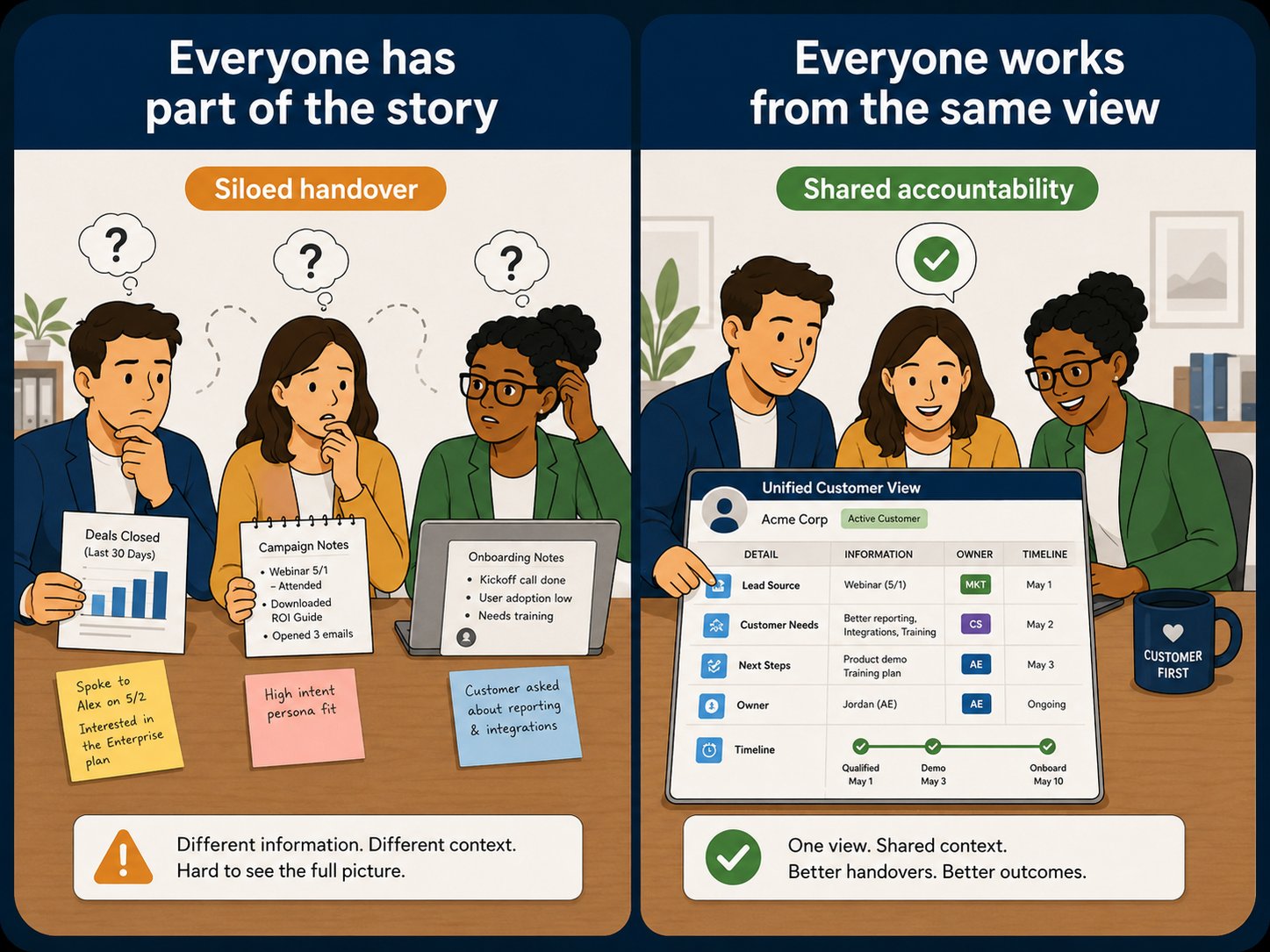 Silos create partial context. Shared visibility creates shared accountability. Image Source: AI-Generated Illustration.
This is where change management becomes critical. RevOps requires teams to change how they define success. A closed deal is not the finish line if the customer journey breaks immediately afterwards. Sales needs to capture the right context, and customer success needs visibility before handover to delivery.
In a RevOps-driven culture, the conversation shifts from “who dropped the ball?” to “where is the journey breaking?”
That shift doesn’t happen just because a process exists. It happens because leaders reinforce new behaviours, teams are guided through the change, and everyone understands how shared visibility improves revenue outcomes.
- The reality check: RevOps creates a single source of truth, but it only becomes valuable when teams are willing to use the data honestly.
Leadership sponsorship turns change into momentum
Change management doesn’t only live with the project team or the person managing the CRM. It has to be reinforced by leadership. We’ve found that a RevOps transformation loses its pulse the moment leadership stops looking at the data.
Teams take their cues from what leaders actually use, ask for, and measure. If leadership says HubSpot is the single source of truth but still asks for pipeline updates in a spreadsheet, the message is clear: the CRM is optional, but the spreadsheet is what really matters.
That is how adoption starts to slip, and the issue isn’t the technology; it’s the behaviour being reinforced.
Strong leadership sponsorship means making the new way of working visible and consistent. It requires operational integrity. It means refusing to report on data that doesn't exist in the CRM. It means pulling up a live dashboard during a meeting rather than a slide deck. When leaders model the behaviour they expect, they remove the option to ignore the process. That consistency is what turns a one-time RevOps project into a permanent operating rhythm.
Is your CRM supporting adoption or creating workarounds?
RevOps adoption isn’t just about asking people to change; it’s about building systems that make that change possible. If the CRM feels harder than the spreadsheet it replaced, teams will quietly go back to the spreadsheet.
A CRM should guide behaviour without creating friction. For example, forcing a rep to fill 15 mandatory fields to move a deal forward rarely improves reporting. Instead, it leads to placeholder data and reps who avoid the CRM until the very last minute. The result is technically complete data that no one can confidently use.
To build for adoption, we have to ask: What information is truly needed, when is it needed, and who actually benefits from it?
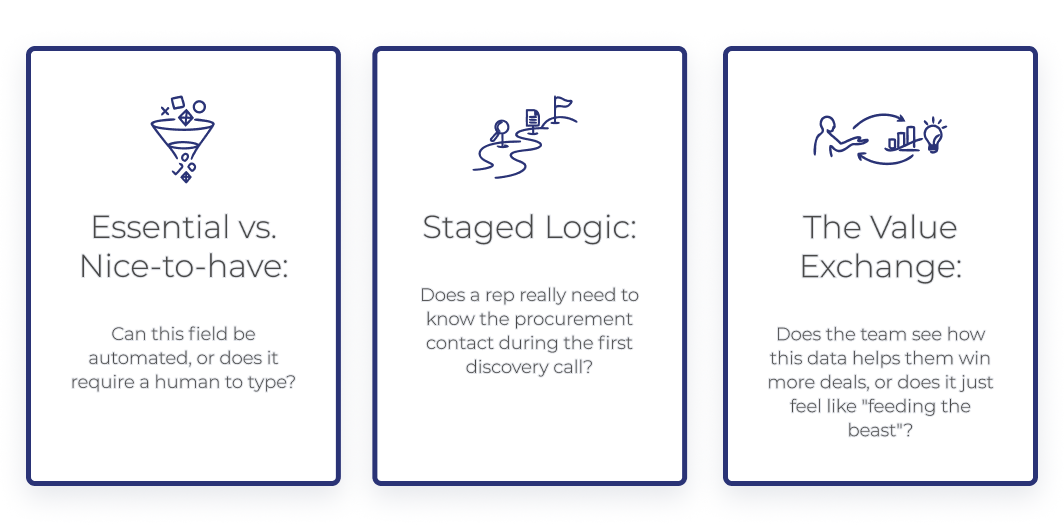
The goal isn't the most detailed system possible; it’s the one that supports consistent behaviour. When processes reflect how teams truly operate, adoption improves. When adoption improves, your data ultimately becomes a reliable foundation for growth.
The cost of poor RevOps adoption
Ignoring the human element of RevOps carries a real cost. It is not just the sunk cost of the software; it is the opportunity cost of poor decisions, missed signals, and slow responses.
When adoption is low, you are not just dealing with messy dashboards. You are dealing with:
- Wasted budget: Marketing continues investing in channels that sales has already written off because feedback is not being captured or shared.
- Higher churn risk: Customers feel the friction of internal silos when expectations, promises, and handovers are not aligned.
- Inaccurate forecasting: Leadership makes hiring, capacity, and growth decisions based on gut feel because CRM data is incomplete or out of date.
Poor adoption does not just weaken your CRM. It weakens your ability to see what is working, fix what is broken, and grow with confidence.
This is why RevOps needs more than a technical implementation. It needs an approach that manages the human, operational, and behavioural side of change from the start.
The ultimate goal of Revenue Operations isn’t a perfectly configured CRM. It’s aligned teams who can make better decisions, serve customers more consistently, and grow with confidence.
Technology provides the engine, but change management is what keeps it moving. Once the foundations for adoption are in place, the next question is what that looks like in practice. In our follow-up article, we show how this approach comes to life through real Spitfire Inbound implementation examples.
Need help making RevOps stick?
Speak to one of our RevOps experts about building a practical, adoption-led approach that supports your people, your processes, and your growth goals.