The world has evolved… with the boom in AI and customers expecting more from brands every day, your teams need to adapt and function as a single revenue-generating engine, rather than siloed departments. This is where a strong RevOps strategy becomes essential for business success.
Revenue Operations (or RevOps) is not just an operational or sales function, it’s a strategic framework that aligns ALL the revenue-generating teams in a business around a single goal. And almost all teams in your business are there to help generate revenue, from marketing attracting leads, to sales converting leads to customers, and service keeping those customers happy.
This article breaks down how we build successful RevOps strategies that connect people, processes, and technology across the entire revenue lifecycle to drive impactful, scalable business growth.
Why you need a robust delivery framework to support RevOps
While every business and client is different, having a strong strategic framework for projects is key. Over the years, we’ve refined a structured way of working that ensures we develop robust RevOps strategies that can be executed with confidence. We call this our Navigator Approach, which is built around five connected phases:
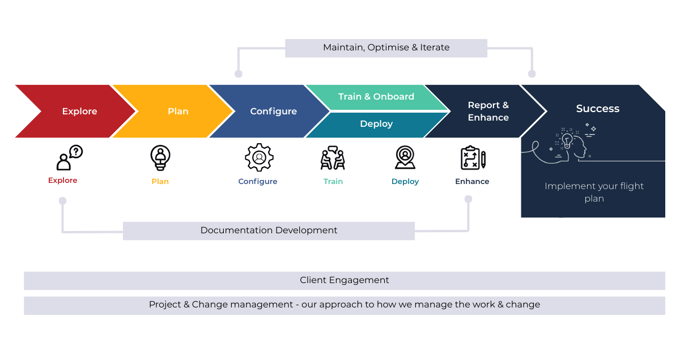
Unpack the full Navigator Approach in our blog: The Spitfire Navigator Approach: A 5-Step Business Framework for RevOps Success
Applying the principles in our Navigator Approach when developing your RevOps strategy is a key factor in our success.
You can spend days in the Explore and Plan phases, but as you execute on the approach, new insights often emerge once sales, marketing, and service teams start engaging with the strategy development in practice. That’s why a strong RevOps strategy needs to be fluid, built on a solid foundation but flexible enough to evolve as real operational gaps, dependencies, and handovers come to light. While the first two phases of our approach focus most heavily on shaping the RevOps goals, processes, and systems, alignment doesn’t stop there. Each phase and engagement with team members refines your strategy to ensure it continues to support how teams work together across the full customer lifecycle.
That ongoing refinement is intentional. By pressure-testing assumptions and validating decisions at each stage, the strategy evolves alongside real insights from the business. This ensures that the strategy evolves with input from all teams, keeping everyone aligned around shared goals, data, and processes.
What’s most important to understand is that a RevOps strategy is not complete if it’s been limited to the team you’re engaging with at the time. For example, if we’re working on a CRM implementation project that is focused specifically on HubSpot Sales Hub, the strategy should never be siloed to sales alone. Sales relies heavily on marketing for lead qualification and handover, while service plays a critical role in defining how customers are transitioned post-sale. Without this cross-team input, the strategy quickly breaks down and your revenue goals are impacted.
This phased approach also removes friction during implementation. Because each phase feeds the next, sales, marketing, and service move forward with clarity and confidence. By the time delivery begins, decisions are already agreed, stakeholders are aligned, and teams are working from the same playbook. The result is a smoother rollout, faster adoption, and a RevOps strategy that drives impact across the entire revenue engine.
Where technology meets strategy
A RevOps strategy has the most impact when teams share a single, clear view of the customer journey. To achieve this, it is essential to understand, the tools and data that will support it in practice. Together, strategy and technology determines how data flows, how teams collaborate, and how performance is measured across the revenue engine.
Using HubSpot as our preferred tool, we understand how data can be structured, visualised, and shared across teams. This helps shape the plan as we understand how the teams will actually work and where there might be some complexity.
That being said, your strategy should never be driven by the technology alone. The technology exists to enable and strengthen the strategy, not dictate it. A successful RevOps strategy will unify people, process, and technology around the business goals.
What should you focus on when building a RevOps Strategy?
Our approach starts in the Explore phase, this is where we’re gathering all the key insights into your business goals, technology, people, and processes. When we’re in this phase, we focus on some key elements:
-
Getting the right stakeholders in the room
A good strategy cannot be built in a vacuum. Before you even kick off, make sure all the right people are in the room… even if they think they don’t need to be there. Having just one critical voice missing will lead to blind spots.
It’s also important to manage those stakeholders, if your focus is on building a marketing strategy, sales and service teams need to know they are there to help surface friction, competing incentives, and hidden dependencies so that the strategy doesn’t cause more blockers.
-
Understanding the current state
Before you can build a new (or optimised) strategy, you need to understand what the current state is. What are the current friction points? What data do you have, and what is missing?
Think about this as if you’re diagnosing reality. But remember, the goal isn’t to assign blame or catalogue every imperfection. It’s to create a shared, objective baseline that everyone understands. Only then can improvements be prioritised with confidence and change implemented without resistance.
-
Asking why, why, why
Being a good strategist is kind of like being a toddler, when a toddler constantly asks ‘Why’, it’s because they are seeking explanations for everything, from simple facts to their own feelings, and it's their way of connecting and making sense of their limited life experiences.
Surface-level answers rarely reveal the true state of things. That’s why we always ask just one more ‘why’.
We dig into why processes exist, why metrics are measured the way they are, and why teams behave the way they do. Then we ask again. And again. Each “why” strips away assumptions until the true driver, or roadblock, of revenue performance is exposed.
- Reporting is not an afterthought
When we build a strategy for a client, whether across sales, marketing, service, or the entire business, we start with a single guiding principle. How will this be reported on, and how will that reporting be used
Ultimately, reporting should help shape your strategy, not react to it.
Once we understand the current state, have asked the why's, dug into reporting, and reviewed all documentation (yes, that’s still important), we move into the Plan phase. This is where insights turn into action.
In the Plan phase, we develop the documentation which will drive the strategy and serve as a base to always refer back to. When building this documentation, we focus on:
Not every issue needs to be solved at once. We identify the changes that will have the biggest revenue impact without overengineering the solution. It’s good to keep ‘wish list’ items that enhance the strategy down the line.
-
Clear success criteria
Defining what success looks like, how it will be measured, and when it should be achieved. No vague goals, no moving targets.
-
Ownership and accountability
Assigning clear owners to outcomes, not just tasks, to avoid execution gaps later.
-
Future-state process design
We think about how a build now could affect the strategy in the future. If you’re only planning for the sales team now, thinking about how the data will be used by marketing later on will ensure your strategy is future-proofed.
-
The technology supports the strategy
It’s vital that you understand what technology is going to be used to support the strategy when you’re planning. But it’s key to ensure the technology supports the strategy, rather than dictating it.
-
A shared flight plan
Creating a clear plan that outlines what is changing, why it matters, and how it will be rolled out across teams.
The Plan phase ensures execution is intentional, aligned, and scalable, setting the foundation for a RevOps strategy that delivers real, measurable impact.
When do RevOps strategies fail?
The short answer… when teams continue to work in siloes - and this is made worse when you don’t surface the key revenue goals and results to the full team!
A strong RevOps strategy won’t fail because of a lack of effort. It’ll fail because of a lack of alignment. It fails when decisions are made in isolation, insights are gathered without full context, and execution happens without shared ownership. Even the most detailed process mapping can fall apart if the right people are not in the room at the right time.
When a key stakeholder is missing, blind spots appear. Assumptions replace reality. What looks efficient on paper can quickly unravel in practice, forcing teams into reactive changes that could have been avoided.
This often leads to a familiar pattern. A strategy is built, launched with confidence, and then quietly reworked a few months later once friction shows up in the data. At that point, teams are not optimising. They are repairing.
In a nutshell, a High-impact RevOps strategy should be designed to evolve, not restart. The objective is to make continuous, data-driven improvements as the business grows, not to rebuild the foundation every time something breaks. That only happens when marketing, sales, customer success, and leadership are aligned from the start and stay aligned as conditions change.
Our approach works because it acknowledges human behaviour, respects cultural nuance, and creates alignment that lasts. When people and processes are supported properly, revenue operations stop being a challenge and start becoming a competitive strength. That is the impact of RevOps when it is implemented with intention and expertise.
Ready to start working on your RevOps strategy? Book a consultation with one of our specialists!
FAQs: