As exciting as AI is, it can’t fix a poorly structured CRM. AI can only work as well as the data behind it. Learn why clean data, strong data architecture, and operational maturity are essential for sustainable AI and how HubSpot helps businesses maintain more reliable, AI-ready operations.
Key Takeaways:
- AI is only as effective as the systems underneath it. AI relies on strong data architecture and reliable operational processes to deliver accurate, high-impact results.
- Clean data is an ongoing discipline. It is not a once-off cleanup project, but a continuous process of maintaining data quality and consistency over time.
- Structure gives AI context. A well-defined data architecture framework helps AI understand relationships between records, workflows, and customer activity.
- Poor data quality weakens AI performance. Duplicate records, inconsistent lifecycle stages, and fragmented processes reduce the accuracy of reporting, lead nurturing, and automation.
- Automation helps maintain operational consistency. HubSpot workflow automation relies on clean, structured data to trigger accurate processes and support more reliable operations.
- HubSpot supports AI-ready operations. The platform helps businesses maintain cleaner data, connected systems, and stronger operational processes through automation and data management tools.
- Operational maturity creates competitive advantage. Businesses with strong data foundations are in a far better position to scale AI successfully than those simply adopting the latest tools.
|
AI is driving a lot of business discussions right now. Every platform promises smarter automation, faster decision-making, and more efficient operations. But underneath all the hype, many businesses are facing a much less glamorous problem: their data foundation isn’t ready for AI.
The conversation shouldn’t start with which AI tool to adopt next. It should start with what problem you’re trying to solve and whether your systems, data, and processes are structured well enough to support AI powered insights.
AI hype is obscuring the bigger picture
The rush to adopt AI has caused businesses to overlook the most important requirement for its success: clean data.
This isn’t just an operational hurdle; IBM reports that nearly half of business leaders admit that concerns regarding data accuracy or potential bias are the main concerns preventing them from scaling their AI initiatives.
While many businesses are already using AI or plan to within the next year, there is a massive gap between adoption and readiness.
In other words, businesses are investing in AI faster than they’re improving the systems underneath it, which leads to unreliable outputs, broken automation, and poor decision-making.
The three data foundations AI depends on
When businesses talk about AI readiness, the conversation often focuses on data quality. But quality is only one piece of the puzzle.
For AI to deliver reliable results, three foundational elements need to work together:
🏗️ Data Architecture
Information needs to be structured and connected in a way that reflects how the business operates. If systems, records, and customer relationships are disconnected, AI struggles to understand context.
🔗 Data Access
The right people, systems, and workflows need access to the right information at the right time. When data lives in silos or is difficult to access, automation and AI become far less effective.
✅ Data Quality
Even the best architecture and access controls cannot compensate for inaccurate, duplicate, or incomplete information. AI relies on clean, reliable data to generate useful outputs.
What is clean data?
Clean data isn’t just about removing duplicates or fixing spelling mistakes. It’s an ongoing process of maintaining a reliable environment in which systems, automation, and reporting can function properly.
As businesses grow, data naturally becomes more complex. Teams capture information differently, processes change, and customer information constantly evolves. Without structure and consistency, CRM data becomes diluted and siloed over time.
In practice, a clean dataset requires:
- Standardised properties and naming conventions
- Accurate lifecycle and pipeline data
- Reliable segmentation for lead nurturing
- Consistent triggers for automation
- Governed processes for capturing and updating information
Without this, even the most advanced AI tools struggle to produce useful outcomes. In some cases, AI can even amplify existing data quality issues, making them harder to identify and resolve.
Why is data architecture important for AI?
Clean data is only one part of the equation. AI also depends on your data architecture: how information is structured, connected, and managed across the business.
Remember, AI can’t understand your business the way people do. It relies on patterns, relationships, and historical information to make decisions.
That means context matters.
Many businesses still treat their CRM as a filing cabinet: a place to store information. But to be AI-ready, you must treat it as a connected system. This means moving away from flat data toward a multidimensional data architecture framework.
When you define how a Lead relates to a Company and how that Company relates to a Partner, you’re giving the AI the context it needs to navigate your business logic.
Ultimately, the goal is to create a single source of truth, so AI doesn't have to guess. By enforcing strict data governance at the architectural level, you ensure that the AI spends its processing power generating insights rather than reconciling conflicting data points.
Forecasting vs. guesswork in practice
The difference between disconnected data and a structured CRM becomes much clearer in real-world use cases like sales forecasting.
Imagine asking AI to identify which deals are most likely to close this quarter. In a poorly structured environment, where pipeline stages are used inconsistently or historical data is incomplete, the AI’s predictions become unreliable very quickly. It may prioritise deals simply because they’ve been open longer, without recognising that there has been little engagement or activity for months.
In a structured CRM environment, the AI has far more context to work with. It can identify patterns between engagement history, lead source, deal progression, and historical conversion trends. Because the system is learning from cleaner operational signals, the output becomes something teams can actually trust.
- This is also why many AI agents struggle inside CRM systems: they rely heavily on clean relationships, reliable workflows, and structured operational data.
How HubSpot automation supports AI-ready operations
Clean data and strong data architecture create the foundation for AI, while automation helps maintain it.
This is where HubSpot adds value.
In many cases, data quality issues rarely stem from a single, major failure. Instead, they creep in gradually through duplicate records, inconsistent formatting, and gaps in how information is captured. Over time, this weakens reporting, disrupts workflows, and inevitably leads to the kind of guesswork that results in failed AI projects.
HubSpot addresses this by embedding data hygiene directly into its operations, rather than leaving it as a manual task. Key features that support this include:
- Deduplication: HubSpot’s deduplication tools use machine learning to identify and merge duplicate records, ensuring you maintain a single source of truth.
- Breeze AI in workflows: You can use Breeze within your HubSpot automation to categorise, standardise, and format data the moment it enters the system.
- Data Quality Command Centre: These monitoring features allow teams to identify structural problems, such as property inconsistencies or orphaned records, before they have a chance to affect your AI-driven insights.
|
These may sound like small fixes, but they often create immediate operational value. A workflow that validates email addresses before a contact enters a nurture sequence can reduce failed sends and improve lead follow-up. Formatting phone numbers consistently can help sales teams contact leads faster and keep reporting cleaner. Standardising fields such as industry, lead source, and lifecycle stage can make segmentation, automation, and reporting far more reliable.
These everyday improvements make AI-ready operations more realistic. Clean data is not only about big CRM projects. It is also about the small, repeatable processes that keep information useful as it moves through the business.
|
💡This becomes even more important as businesses adopt AI agents and assistants within their CRM. These tools can only be as effective as the data, workflows, and business logic supporting them.
The ultimate value here isn't just clean records; it is a reliable operating environment. By shifting HubSpot data management from a reactive cleanup project to an automated, day-to-day process, businesses can automate with confidence.
When your data is governed at the point of entry, you provide your AI tools with the context they need to produce meaningful outputs. This consistency is what transforms a CRM from a passive database into a predictive growth engine.
Understanding the theory of data architecture is one thing; seeing how it applies to your own CRM is another. Before investing further in AI, use our AI-Readiness checklist to see if your foundation is built for growth or if there are gaps that still need attention.
The CRM AI-Readiness Checklist
AI is getting a lot of attention right now, but before you plug in another AI tool into your CRM, it’s worth asking the question: Is your data ready to support it?
AI is incredibly smart, but it’s also a mirror. If you feed it messy data, it’s just going to scale the mess faster. Use this checklist to see where your CRM is in good shape, and where it may need a little work before AI can deliver real value.
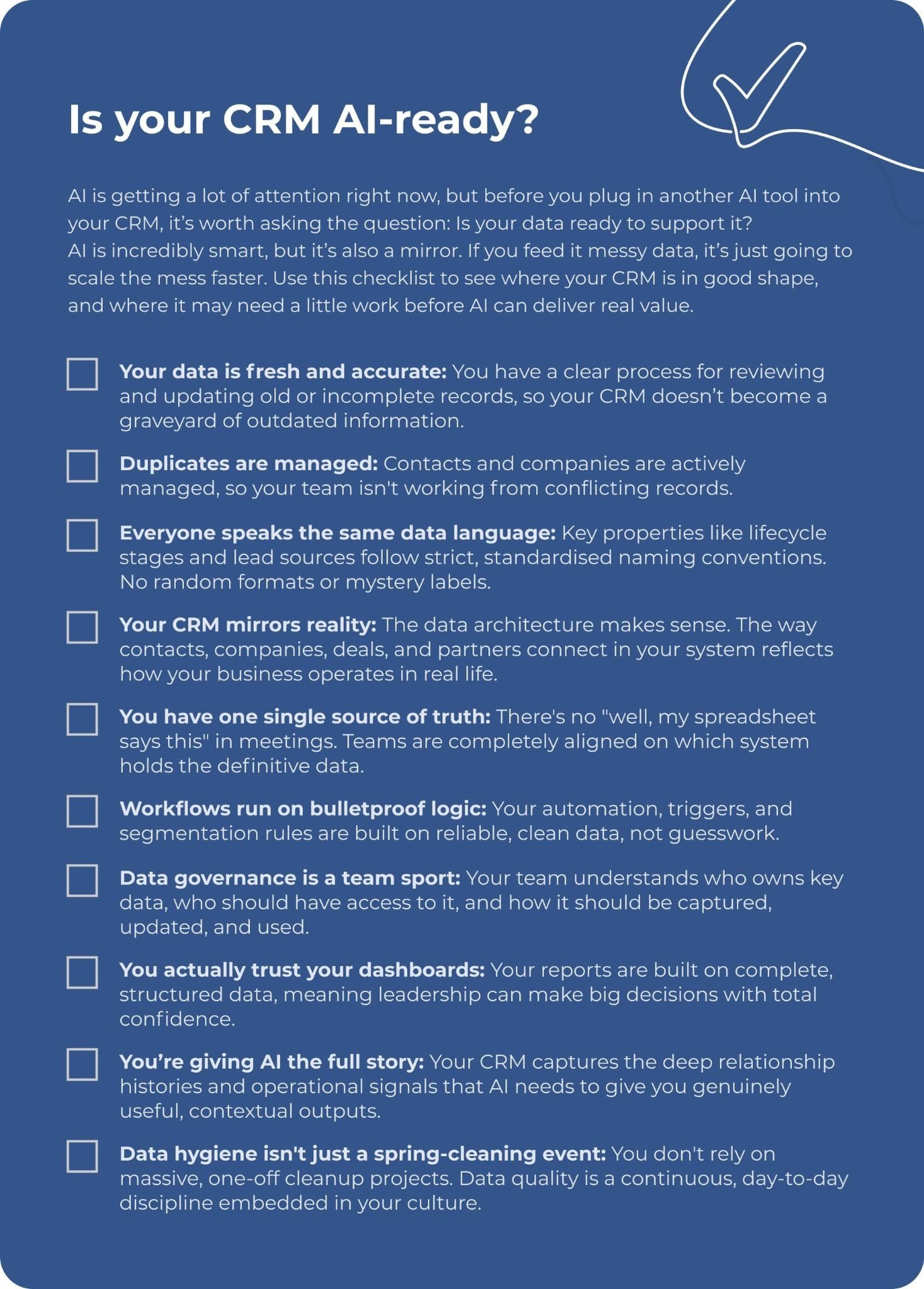
So, how did you score?
Checked fewer than 5 boxes? Take a breath, you’re definitely not alone, but your AI initiatives are likely going to hit some serious friction.
The next step for your business isn't necessarily buying more AI tools. It’s fixing the data environment that AI depends on. The stronger your data foundation, the more likely AI is to deliver real, scalable value.
Instead of chasing the latest feature, focus on the operational discipline that turns your information into a genuine asset.
Checked 5 or more boxes?
You’re in a stronger position, but that doesn’t mean the work is done. Your data and processes are structured enough to support AI automation and reporting, which means you can start thinking more practically about where AI can add value.
Your next step is to identify specific use cases where AI could save your team time, improve decision-making, or remove manual work from everyday processes.
💡Remember: data quality still needs ongoing care. Keep your current habits consistent so your AI tools continue to return accurate, useful results as your business grows.
Completed the checklist and found a few gaps?
That doesn’t mean AI is out of reach. It means the operational foundation underneath it needs attention first.
We can help improve your CRM data quality, strengthen automation, and build the operational structure needed for AI to deliver meaningful results.
Book a consultation to take the next step.