Key Takeaways
- Growth outcomes focus on closing the confidence gap in AI through a four step process of Diagnose, Prescribe, Build and ProveGrowth Context is the layer that helps AI know the business, not just respond to prompts.
- Growth context combines customer, business, team, process, and custom context into a usable operating foundation.
- Weak context leads to generic output, poor handoffs, and more human correction.
- Strong context helps turn AI into better execution across marketing, sales, and service.
- HubSpot’s Diagnose, Prescribe, Build, Prove logic closely mirrors Spitfire’s Navigator Approach
|
HubSpot’s UNBOUND 2026 theme is centred around Growth Outcomes.
Since AI came on the scene, most conversations about AI have focused on capability: creating faster, automating repetitive tasks, and saving time. Those are fair measures, but they’ve consistently proved to be too narrow. We all know that AI exists, focusing on growth outcomes is what will close this confidence gap.
The product features unveiled at UNBOUND are anchored around three specific, high impact results - what changed, what it cost and how long it took to get there.
Four Steps to Creating Growth Outcomes
The strategic promise behind HubSpot’s framing focuses on an intentional and measurable methodology: Diagnose, Prescribe, Build, Prove, a far more disciplined model than simply enabling features and hoping they create value:
- Diagnose what is broken and define the baseline. Write down this starting number!
- Prescribe a clearly scoped plan the business can commit to.
- Build the agents, workflows, campaigns, and operating structure required to support it.
- Prove the outcome by measuring the same commercial reality you set out to improve.
Businesses don’t gain a competitive edge simply by adding AI tools. They gain a competitive edge when those tools understand the business well enough to support better decisions, better execution, and better outcomes.
Growth outcomes can be grouped into three distinct areas:
- Build Demand
- Win Deals
-
Delight Customers
However, beyond capability, AI tools need to understand the context with which they work.
What is Growth Context?
Growth Context is the specific and dynamic understanding of a business, team, and customers that AI needs to drive outcomes in the moment. It is the difference between AI that responds to prompts and AI that knows the business.
That may sound straightforward, but it marks an important shift. If we are honest, the first wave of AI adoption happened without sufficient structure to support it. Teams experimented only to find that the outputs tended to be too broad or too narrow, too shallow or too in depth, or too disconnected from day-to-day reality. In many cases, the challenge was that the tool lacked the required context.
Instead of asking AI to operate solely on prompts, Growth Context gives it a working model of the business:
- who you serve,
- what you sell,
- how you position it,
- how your teams operate, and
- what good performance looks like.
The whole picture.
Where Growth Context connects with the Spitfire Navigator Approach
At Spitfire Inbound, we already work with ‘growth context’. In fact, it’s one of the core strategies we use with our clients.
The diagnose, prescribe, build, and prove methodology closely mirrors our existing Spitfire Navigator Approach. Both are built on the idea that growth improves when understanding comes before execution.
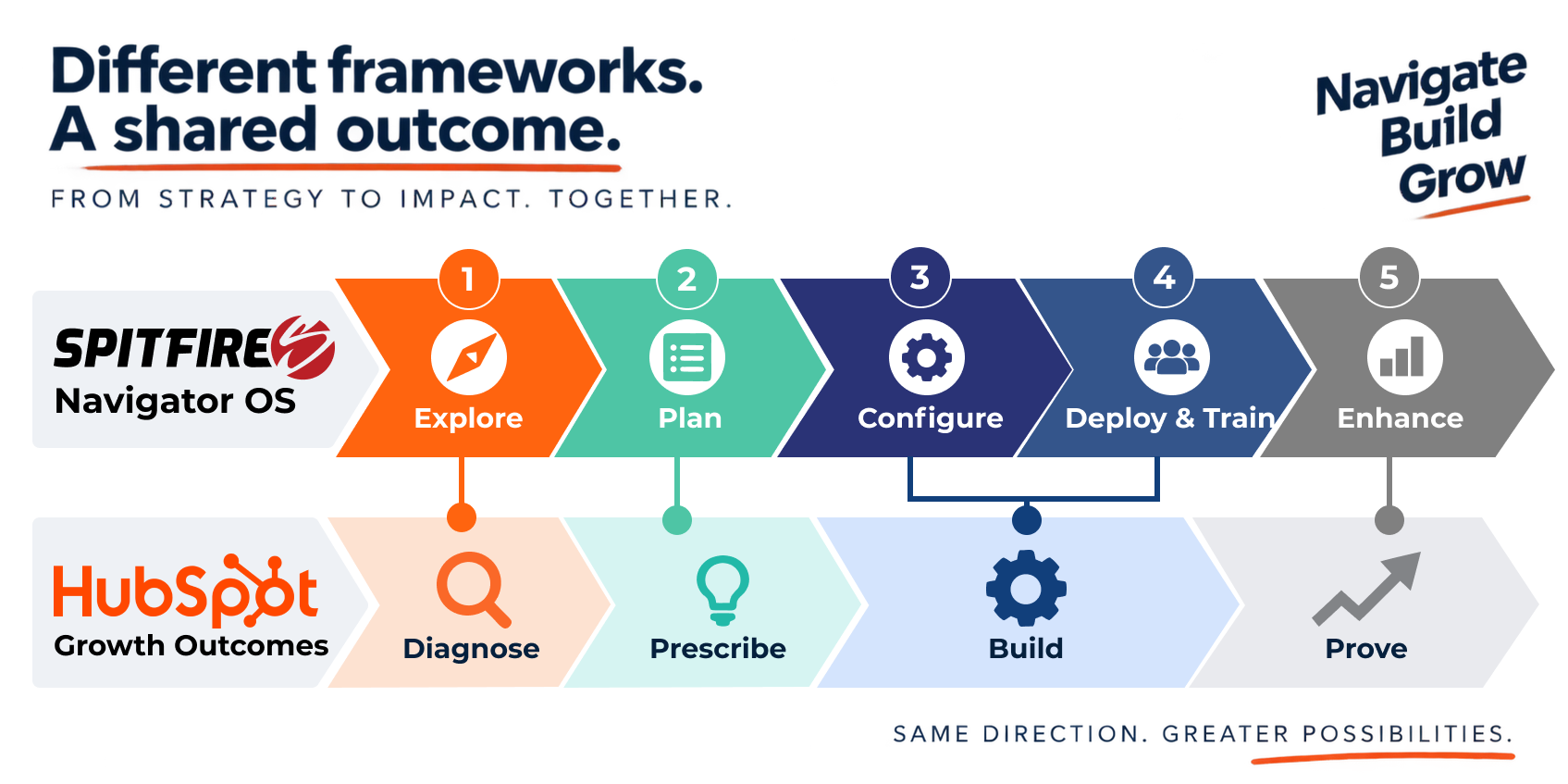
Here’s a step-by-step breakdown:
In our Growth Navigator OS, we start with Explore. This is where customer context, business context, team context, process context, and custom context are assessed. You can’t improve what you haven’t understood, and you can’t operationalise context that you can’t see. This aligns with HubSpot’s Diagnose stage. Explore includes setting clear measure of success - and capturing those to measure against!
Next we move to Plan. Commercial priorities are clarified, friction points are identified, and scope is finalised. This corresponds with HubSpot’s Prescribe stage.
Configure is where context is translated into structure inside the platform: lifecycle stages, handoff logic, workflows, reporting, automation, data models, and operating rules. In other words, Growth Context becomes executable. This forms the first part of HubSpot’s Build stage.
The second part of HubSpot’s Build stage relates to our Deploy & Train. Context only creates value when teams can use it consistently. If the platform is configured well but the team isn’t aligned around it, the business still falls back into fragmented execution. This stage turns system design into day-to-day operating reality.
Finally, there is Enhance where work is measured, refined, and improved over time. Context is not static; it needs to be maintained, expanded, and sharpened as the business grows - aligned with HubSpot’s Prove stage.
Growth Context and the Navigator Approach are solving the same problem: turning context into measurable progress in the business. Same direction, greater possibilities.
Why Focus on Outcomes and Context?
Growth outcomes built on context marks a shift in how AI is expected to work in the business: from simply responding to prompts to actually knowing the business.
HubSpot is a CRM that is purpose built for your business - it is not providing a generic context layer. Every signal, pattern and insight from your AI engine is designed around YOUR go-to-market motion.
Secondly, this context is captured automatically as the team works, the more that the team uses HubSpot, builds on the data, gives feedback, the more precisely the context layer will understand your business.
Thirdly, every team and agent work from the same picture, ensuring that every interaction is built to last.
This specificity is what HubSpot is empowering us to provide better results for our clients; results that can’t be replicated by other AI tools or platforms. HubSpot is creating interconnected systems that drive better outcomes when they are built on the underlying customer, business, team, and process context inside the platform itself.
The Five Types of Context
HubSpot breaks context into five types that make it usable in practice. HubSpot’s framing treats context as a set of connected layers, each of which shapes how the system understands the business as a whole.
-
Customer context: This covers the full history of marketing, sales, and service interactions, along with lifecycle stages, buyer profiles, account behaviour, and computed signals such as scores or sentiment. This is what helps teams and systems work from real demand signals rather than assumptions.
-
Business context: This includes your brand, business profile, products and services, positioning, and competitive landscape. It is the difference between a system recognising the company and understanding how that company creates value, where it sits in the market, and how it should be represented.
-
Team context: This is how the team actually works and what makes them successful: responsibilities, standards, approvals, handoffs, user profiles, and even the way strong operators communicate. Without this layer, outputs can be technically correct and still miss the mark operationally.
-
Process context: This includes routing rules, handoff criteria, qualification logic, workflows, pipeline stages, service procedures, and the documented logic behind how work gets done. Process context is what connects understanding to execution.
-
Custom context: This is where the nuance lives: free-form guidance, uploaded files, regional realities, competitive detail, client-specific complexity, and vertical-specific knowledge that does not fit neatly into a standard field. It’s usually missing or incomplete in a client's portal. It’s often the difference between a system that is broadly informed and one that is genuinely useful in a specific business environment.
Put together, these layers form a shared operating foundation. They give humans, automations, and agents a closer version of the same truth to work from.
Important to note is that while it is possible to configure the context at set up, it is vital to keep this updated over time. As you engage as a team and with your clients, ensure to keep your context layers up to date.
How context directly relates to growth
Context is a commercial asset, it affects the quality of decisions, the consistency of delivery, the speed of execution, the credibility of reporting, and more.
When businesses lack shared context, they tend to experience the same problems repeatedly: fragmented handoffs, uneven messaging, disconnected systems, weak automation, and disconnected reporting that can’t explain what is actually happening (and why).
In other words, poor context creates drag.
Strong context, by contrast, improves alignment. It gives the business a better baseline for action. It helps teams operate from the same understanding of the customer and of what growth requires.
Growth Context is about reducing operational friction in the business to positively impact revenue, retention, and scalability.
Final thought
Growth Outcomes built on context is the difference between technology that looks promising and technology that produces measurable results. When outcomes are defined and context is clear, connected, and operational, AI becomes more useful to the people doing the work and more valuable to the business as a whole.
Ready to make AI more useful to your business? Start by understanding where your customer, business, team, and process contexts are still disconnected.