Key takeaways
- The modern customer journey is not linear: rather than following a straight line, it resembles a piece of string art, where the "nails" represent individual brand touchpoints and the "string" weaves an organic, often unique and sometimes complex path between them.
- Customer experience is cumulative: a customer's overall perception of a brand is not formed by a single interaction, but by the cumulative effect of all individual touchpoints.
- Conversion requires multiple touchpoints: trust is built through repeated interactions over time. It typically takes 3 to 5 touchpoints to convert a B2C customer, and 6 to 8 touchpoints to convert a B2B customer.
- Journeys involve hidden touchpoints: many crucial touchpoints occur entirely outside a brand's direct control. This includes interactions such as private social sharing, third-party reviews, and AI-generated answers.
- Brands must influence unowned touchpoints: while you cannot control what a third-party site or an AI engine says about your brand, you can influence them by consistently publishing highly referenceable content that these tools naturally want to cite.
Do you remember playing with stringboards as a kid?
You’d start with a wooden board and a handful of nails. Once the nails were in place on the board, the fun would begin. You’d take some coloured string and weave it between the nails, looping one to another, trying to make something.
Some of us set our nails up in a specific way, like the outline of a heart or a spaceship. Some of us chose to wing it but either way, if we were patient, we’d start to see a picture form.
This may not match the one we set out to create but it reflected our journey in creating our masterpiece..
Why are we talking about childhood games, you ask?
Well, because string art is a lot like the customer journey.
The customer journey, explained through string art
In the past, businesses set out to create a curated, linear customer journey. Someone sees your ad, clicks through to your website, fills out a form, receives a nurture email, speaks with sales, visits your website, downloads a guide and eventually becomes a customer. All nice and neat and in our control.
But that’s not how things actually work because people don’t behave in a linear way.
Today’s customers move through a far more complex journey. They discover brands through social posts, partner pages, review sites, AI-generated answers, podcasts, industry articles, recommendations from colleagues, and dozens of other sources before they ever land on your website.
Each of those moments is a touchpoint; a nail. And if you were to map them visually, the journey would look less like a line and far more like string art. A board full of nails connected by threads moving in every direction.
Every nail represents a place/touchpoint where someone might encounter your brand, and every piece of string represents the path they take between those encounters. The finished picture only emerges when all those interactions connect.
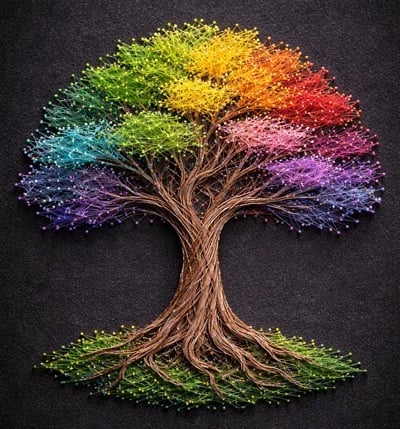
Image created with ChatGPT
Which raises an important question: if the customer journey looks like this, are we paying enough attention to the nails on the board?
Why touchpoints matter
People rarely make decisions after a single interaction, especially these days. We have to earn each customer's trust, and that takes time. People need to see your brand more than once. They need to encounter it in different contexts, through different sources, and at different stages of their thinking - all the while experiencing consistency which ensures that your brand feels credible.
For example, someone might first see a social post and become aware that your brand exists. Later, they might read a blog that explains a problem they are trying to solve and start investigating solutions. At some point, they may look up a review or ask an AI tool about the solution, and your brand pops up again. Only after those interactions do they decide to visit your website.
Each touchpoint has a question attached.
At the beginning, the question might simply be, “Who are these people? This looks interesting”
Later, it becomes, “Do they understand the problem I have? What is their level of expertise in my industry”
And eventually, “Can I trust them to solve it? Are they the correct partners for my business”
No single piece of content or interaction offers the entire journey. Instead, it’s the combination of touchpoints that brings people to your website or inbox. Through consistency and aligned teams, the string between the nails make sense.
Let's look at touchpoints from three perspectives:
-
Customer journey touchpoints you own
These are the nails you hammer in yourself: your website, blogs, emails, events, PR articles, sales and customer service staff training, collateral material and social media pages. Here, you control the narrative, the "colour of the string," and exactly what the customer sees. You shape the story you want to tell.
These touchpoints form the foundation of your brand’s presence. They assist clients and prospective clients to understand what you do (and why you do it!), they allow you to listen to truely understand their challenges and to then demonstrate your expertise.
They have a role in guiding people toward the next step in their journey with you
Customer journey touchpoints you influence
These are the nails that other people hammer in on your behalf based on what they know about you. And these nails appear on the board whether we like it or not. This includes: review sites and forums (e.g. Reddit), media and PR (e.g., a journalist's column, an industry-specific publication), customer reviews (HubSpot Partner Page) and AI tools (e.g., ChatGPT, Perplexity, Gemini).
From a customer’s perspective, these points are often more valid and trustworthy because they are seen as objective.
It becomes social proof. If a customer asks an AI tool for a recommendation and your brand pops up, that is a massive touchpoint in their journey that you didn't directly place, but you certainly influenced through your overall digital presence.
Customer journey touchpoints you didn’t know existed
The beauty of our string art analogy is that the journey doesn’t look like you expected. The most interesting thing about mapping touchpoints is discovering how many already exist.
For example, when we look at referral traffic in HubSpot, we often find "hidden nails", places like niche partner pages, that are driving high-quality leads. Offline touchpoints also play a role. Sponsorships, events, media mentions, or even conversations between people can send someone looking for your brand before they interact with your marketing.
The moment you start identifying these unexpected touchpoints, you begin to see opportunities.
Maybe there’s an industry publication that regularly covers your sector but hasn’t mentioned your brand (yet). Maybe a partner page drives more interest than you realised. Perhaps AI tools are surfacing information about your brand from sources you haven’t looked at in years.
The more we know about how people come across our brand, the better we can create strategies that take these into account - it allows us to engage with these touchpoints and often develop strong relationships.
Try not to approach these discoveries with frustration or a feeling of powerlessness. Rather, approach them with curiosity! You never know what you will uncover.
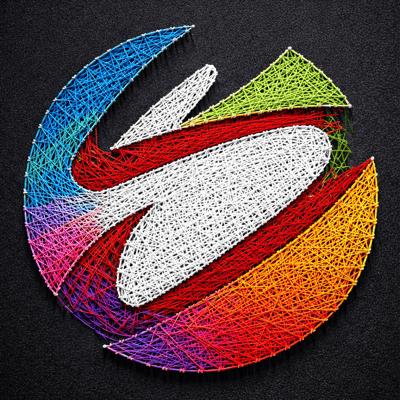
Image created with ChatGPT
How to influence what you don’t control
You can’t rewrite a review or dictate what an AI model says about your brand. But you can influence what information some sources have available to draw from. The best way to do that is by creating content others naturally want to reference.
Original data, clear explanations, useful frameworks, and well-structured insights give writers, analysts, and AI LLMs something reliable to cite. Over time, that material will start appearing across different platforms, strengthening your presence across the broader ecosystem.
This is also where strategies like Generative Engine Optimisation (GEO) and AI Engine Optimisation (AEO) make a big difference. AI tools summarise information from various sources, and brands that consistently appear across credible publications and referenceable content are more likely to be mentioned.
Read our blog about GEO for more information!
Regard your customer’s journeys as unique and allow your strategy to be comprehensive and agile enough to enable them to follow their path to your brand.
Our most valuable growth happens when we stop focusing on the “perfect journey” and start paying attention to the board itself. Where are the nails? Who put them there? And how many of them have we overlooked?
The brands that win are the ones building a strategic presence in specific areas so that no matter where the string begins, it eventually connects back to them through a unique and personalised journey.
Understanding your touchpoints is the first step to building a stronger customer journey.
Take the next step and Book a call with us to discover the touchpoints influencing your growth.