Key Takeaways
- A strong SaaS RevOps strategy aligns marketing, sales and customer service around shared processes, data and revenue goals.
- Clear pipeline stages, ownership rules and qualification criteria improve B2B SaaS pipeline management, handoffs and conversion.
- A connected tech stack reduces tool bloat and gives teams better visibility across the customer journey.
- Metrics such as MRR, net revenue retention, qualified pipeline, win rate and churn help measure how efficiently the business is scaling.
- RevOps should be reviewed and improved as the business grows.
- South African SaaS businesses should also consider local requirements such as POPIA, as well as billing, tax and reporting needs when operating across markets.
|
If marketing, sales and customer service teams are constantly debating whose numbers are right, working from different systems or losing context between handoffs, your revenue operations are already creating friction.
A strong SaaS RevOps strategy brings those moving parts together. With shared data, clearer processes and connected systems, teams can spend less time fixing gaps and more time improving lead quality, retention and recurring revenue growth.
For mid-sized SaaS businesses, RevOps provides the operating structure behind a scalable SaaS growth strategy, without adding unnecessary tools, manual processes or complexity.
What should a SaaS RevOps strategy include?
For a SaaS business, the strategy should cover the full customer journey, from first touch through to renewal and expansion. That means setting clear rules for how marketing, sales and customer service work together, which systems they use, who owns each stage and which metrics matter.
Here’s what that looks like across each team.
1. Align marketing around qualified demand
Marketing’s role in RevOps goes beyond generating more leads. Focus on attracting prospects that fit your ideal customer profile and are more likely to become long-term customers.
Start by agreeing on lifecycle stages and qualification criteria with sales. Rather than relying on a broad MQL definition, define the company characteristics and behavioural signals that indicate genuine buying intent. Build these criteria into your CRM so leads can be scored, routed, and reported on consistently.
For marketing, the priorities should include:
- Centralising campaign and lead data in your CRM.
- Setting clear lead routing rules and response-time SLAs.
- Reporting on pipeline and revenue by channel rather than lead volume alone.
- Reviewing which platforms contribute to qualified pipeline and recurring revenue.
For South African SaaS companies, lead management processes should also account for POPIA requirements, particularly when personal information is used for electronic direct marketing.
2. Give sales a clear pipeline and ownership model
RevOps gives sales teams a cleaner view of the pipeline by standardising ownership, deal stages and the information required to move a deal forward.
A SaaS sales RevOps framework should include:
- Clear account and contact ownership by territory, segment or vertical.
- Consistent pipeline stages with defined entry and exit criteria.
- Required deal information at key stages, such as decision-makers, timing and commercial requirements.
- Automated follow-up for repeatable sales activities, including trials nearing expiry and closed-lost re-engagement.
With consistent data and stage definitions, sales leaders can identify stalled deals, monitor cycle times and build more reliable forecasts.
Need help structuring your own SaaS pipelines? Get in touch with our team for a call.
3. Connect customer service to retention and growth
For subscription businesses, revenue continues long after a deal closes. Customer service therefore needs to be connected to the same revenue system as marketing and sales.
A single view of the customer should give service teams access to relevant sales history, contracts, product usage and support interactions. This helps teams spot potential risks earlier and respond with better context.
Customer service RevOps should focus on:
- Maintaining one customer record across the full lifecycle.
- Using agreed customer health indicators and renewal workflows.
- Triggering proactive outreach when usage drops, or unresolved service concerns emerge.
- Creating processes to identify relevant renewal and expansion opportunities.
4. Consolidate your RevOps tech stack
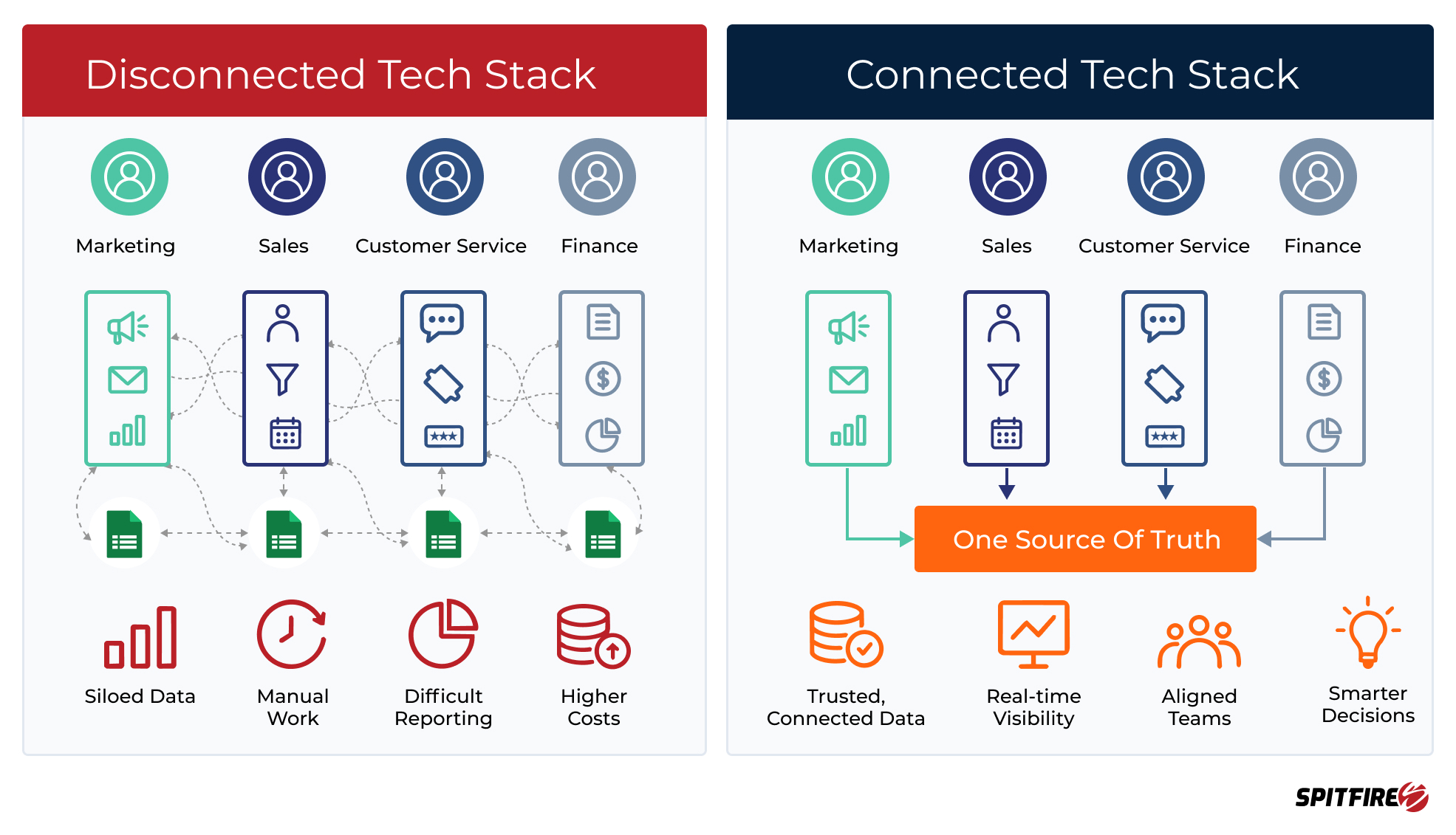
You start with one CRM. Then marketing adds an automation tool, sales brings in another platform, customer service needs its own system, and before long there are spreadsheets filling the gaps between them.
That’s where tool bloat starts to create real RevOps friction. Data becomes harder to trust, teams work from different systems, and reporting takes more effort than it should.
A RevOps tech stack should be designed around your revenue processes. Start by mapping every tool that touches the customer lifecycle and ask:
- What role does this tool perform?
- Is another platform already capable of doing the same job?
- Which system should hold the source-of-truth data for contacts, companies, deals, subscriptions and service records?
A connected tech stack also makes it easier to see revenue data across the business. This is especially important for SaaS companies, where CRM, billing, subscription and finance data often sit across different systems. Sage and Chargebee both highlight the importance of bringing this data together to improve visibility and decision-making.
The goal is a tech stack where your systems work together, your data is connected, and you’re not paying for multiple tools that do the same job.
For South African SaaS businesses serving customers across different markets, the RevOps stack may also need to account for different billing, subscription, tax and reporting requirements.
How do you build a SaaS RevOps strategy?
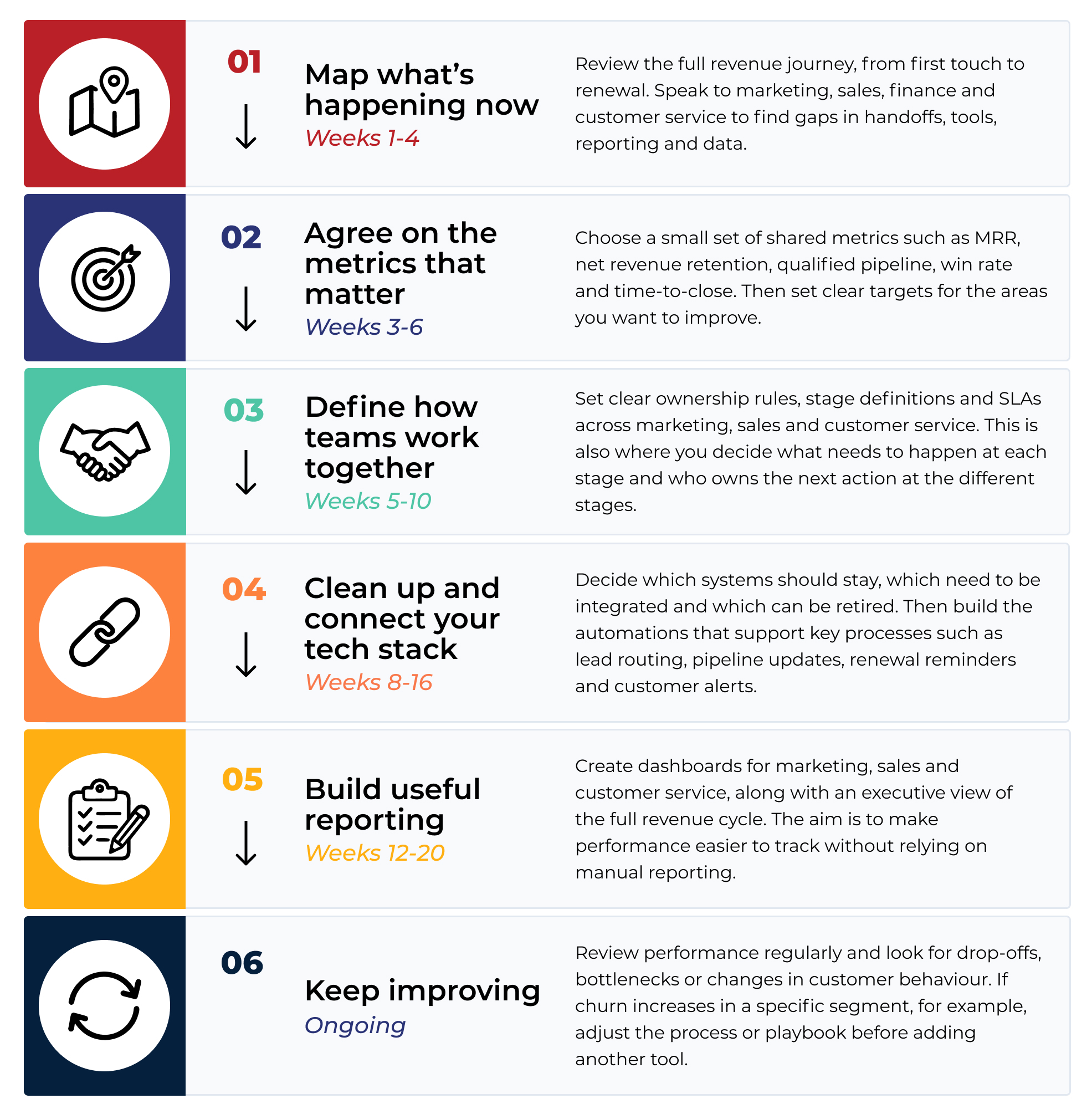
A strong RevOps strategy is built over time, with people, processes and technology working towards the same revenue goals. For a mid-sized SaaS firm in South Africa, a practical roadmap could look like this:
When should a SaaS company consider RevOps consulting?
RevOps consulting for SaaS companies can be valuable when growth starts exposing gaps that are difficult to solve across individual departments.
You may need external RevOps support if:
- Marketing, sales and customer service use different data or definitions.
- Your technology stack has grown without a clear architecture.
- Revenue reporting is inconsistent or heavily manual.
- Leads or customers regularly fall through handoff gaps.
- Existing processes are struggling to support growth.
- Your team understands where the friction sits but needs specialist support to redesign the revenue system.
This is where a strategic RevOps partner can add value by helping align your people, processes and platforms around a shared revenue strategy. See how HubSpot can support RevOps as a Service.
You don’t need to overhaul your entire revenue operation at once. Start with the area creating the most friction, whether that’s lead handoffs, reporting, renewals or an overcrowded tech stack, and build from there. A focused first step makes the wider RevOps journey much easier to manage.
"SaaS companies love technology, so their instinct is to buy it. Every problem gets a tool. Maturity is realising fewer tools is the more valuable position. RevOps needs continuity across marketing, sales, service and customer satisfaction, and HubSpot gives you that on one platform and one data model, so the CEO and the individual salesperson are reading the same number."
- Darren Leishman, Spitfire Inbound CEO
Need support with your RevOps strategy?
We can help you identify where the biggest gaps sit and build a clear plan to address them.
FAQs