HubSpot is moving to an Agentic Customer Platform. We unpack what that shift means, how humans and AI agents could work together, and what businesses need to consider as agentic AI becomes part of everyday operations.
Key Takeaways
- HubSpot’s move to an Agentic Customer Platform signals a shift from AI as a standalone tool to AI becoming part of how work gets done.
- Agentic AI can use context, make decisions and take action within clear boundaries, while people stay involved where judgement matters.
- Context, coordination and action need to work together for agents to deliver meaningful outcomes across the customer journey.
- Businesses should start with a real business problem, then decide where agents can add value and where people should step in.
- Agentic AI can also highlight gaps in process, ownership and team alignment, creating an opportunity to improve how the business operates.
|
Walk into almost any business today, and you’ll find teams using AI for nearly everything. It might be helping to write content, summarise calls, analyse data or speed up admin. The tools are useful, but the competitive advantage depends on something bigger: intelligent systems that can understand context, coordinate and execute together.
AI is already part of how we work. The next step is proving that it can help businesses grow, make better decisions, and deliver stronger outcomes across the customer journey.
This shift is at the centre of HubSpot’s Fall Spotlight announcement: HubSpot is becoming an Agentic Customer Platform.
It signals a move towards humans and AI agents working together with the same understanding of the business, its customers, processes, and teams - having a strong context foundation, the right use cases and a new way to work.
HubSpot calls this growth outcomes.
What does ‘agentic’ mean?
The word “agentic” sounds like jargon, and it can get confusing quickly.
Agentic AI can take a goal, understand the context around it, decide what needs to happen next and take action within set boundaries.
“An agent can execute much faster than a person, but that also means it can execute a bad process faster.”
Agentic AI still needs boundaries. Human judgement, clear guardrails and defined responsibilities all have a role to play, especially when an agent can act on real customer and business data. The goal is to give AI enough autonomy to be useful, while keeping people involved where judgement and oversight matter.

It is essential to highlight that the more responsibility we give AI, the more important its understanding of the business becomes. If an AI agent works with your customer data, processes and business rules, ensure it has a clear understanding of how your business actually works.
What happens when AI becomes part of the team?
Your next colleague might be an AI agent, and the real shift is that it will start to function more like part of the team. This is where coordination plays a role: deciding how humans, agents and systems work together, where responsibilities sit and how those interactions are governed.
Most businesses still think about AI as a tool someone opens when they need help writing, researching or summarising. An agentic model (like HubSpot’s new framework) brings AI much closer to the work itself, where it can help interpret signals, trigger next steps, and keep customer journeys moving forward.
“Agents are not standalone tools; they’re part of the team, another team member. And like any new team member, an agent needs more than just access to the system."
A new hire wouldn’t be expected to succeed with a login and a few disconnected records. You’d give them context about your customers, processes, standards, goals and how the wider team works. AI agents need the same foundation to contribute meaningfully.
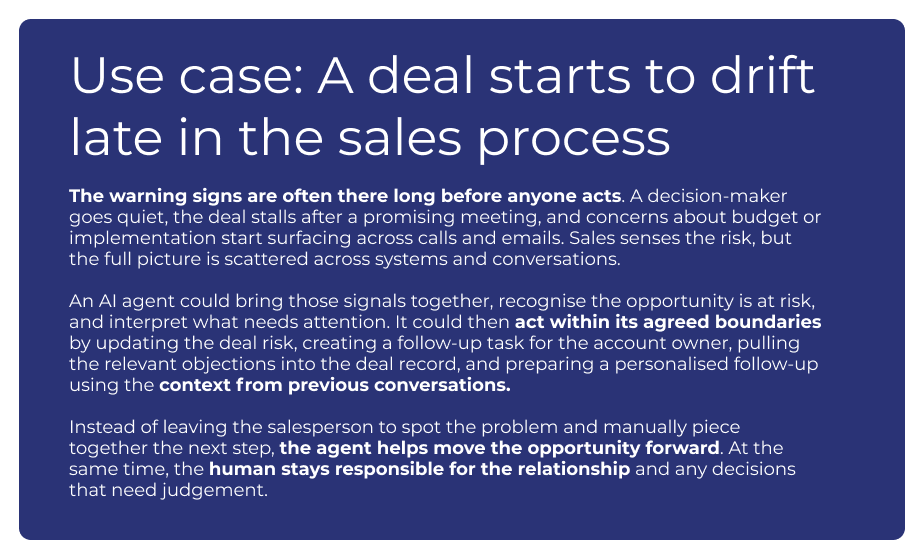
The value of agentic AI becomes clear in situations like this: helping teams spot risk earlier, connect signals they may otherwise miss and act while there is still time to influence the outcome.
A note: businesses could run into trouble when they introduce agents without giving them a clear role, shared context, boundaries or a connection to how the business actually works. The result is often plenty of activity with little impact. Shared context, clear responsibilities and alignment around outcomes matter just as much for agents as they do for people.
We recommend that the question you need to ask yourself is: is your business is ready to make an AI agent a productive member of the team.
How do businesses prepare for an agentic future?
An agentic future changes more than the technology businesses use. It changes who, or what, can make decisions and take action on the business's behalf. This is the action layer of agentic AI: turning context into something that actually happens, whether that is updating a record, triggering a workflow, creating a task or moving a process forward.
That means preparation needs to go deeper than choosing the right AI tools. Businesses need to think carefully about where agents can create value, how much responsibility they should have, and what needs to change around them for that responsibility to work.
1. Start with a business outcome worth improving
Start with a problem that already matters.
“The biggest mistake will be starting with ‘Where can we use an agent?’ rather than ‘What problem are we trying to solve?”
Look for the points in your customer journey where revenue, time or customer experience is being lost:
- Deals that regularly stall.
- Leads that take too long to reach the right person.
- Service issues that escalate before anyone spots the pattern.
- Processes where teams spend hours piecing together information before they can act.
Then work backwards: what would need to happen differently for that outcome to improve, and where could an agent meaningfully contribute?
This gives the agent a purpose from the beginning and makes it much easier to determine whether it is actually working.
2. Decide where agents should act, and where people should step in
As agents become more capable, businesses will need to be far more intentional about who owns each part of a process.
An agent may be able to identify a risk, recommend the next action and execute certain steps independently. But should it:
- send sensitive customer communication?
- change a commercial offer?
- decide how to handle an unhappy strategic account?
There won’t be one answer for every business or every process.
Map out where an agent can act safely, where human approval is required and what should happen when the situation falls outside its normal scope. These handovers need to be designed into the process rather than figured out after something goes wrong.
3. Make AI a cross-functional responsibility
Agents working across the customer journey will rarely fit neatly into one department.
A sales agent may need marketing engagement data, CRM history, commercial information and Customer Service context to make a useful decision. That creates a bigger organisational question: who is responsible for how that agent operates?
Businesses will need clear ownership across teams. Someone needs to define:
- what the agent is there to achieve
- what information it can use
- which actions it can take
- how its performance is reviewed
Without that clarity, different teams can end up expecting different things from the same technology.
4. Measure what changes for the customer and the business
The number of agents running in your business tells you very little about whether they’re creating value.
Instead, connect each agent to the outcome it was introduced to improve.
- Did the sales cycle get shorter?
- Were fewer opportunities lost through slow follow-up?
- Did customers get answers faster?
- Did teams spend less time on repetitive work and more time on conversations that needed their expertise?
It is also worth looking beyond efficiency. An agent can speed up the process and still make the customer experience worse.
Businesses that get this right will keep reviewing both sides: what changed for the business, and what changed for the customer.
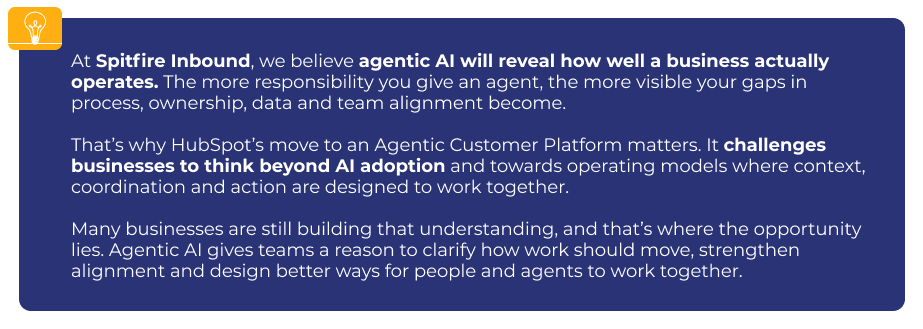
What could agentic AI look like across the customer journey using HubSpot Work?
The value of agentic AI becomes easier to understand when you look at the customer journey as a whole - where agents are able to execute within clear boundaries.
With HubSpot Work, agentic AI can help move actions forward across the customer journey by using shared context to trigger the right next step, support the right person and reduce the friction that slows teams down.
| Use case |
Challenge |
HubSpot action |
Outcome |
| Client onboarding |
A deal closes, but momentum is lost in the handover. Context sits across notes, activities and emails, while onboarding tasks are still created manually. |
Workflows can trigger actions when a deal moves to Closed Won, while checklists can standardise onboarding steps, assign ownership, set due dates and track progress. |
A more structured handover, less context lost and greater clarity for the Customer Service team from day one. |
| Deal desk |
High-value deals can stall when legal, commercial or technical approval is needed, especially when ownership and next steps are unclear. |
Deal approvals can sit directly within the pipeline, while Workflows and task queues can route work, assign owners and trigger follow-up when conditions are met. |
Less chasing, clearer ownership and fewer internal delays holding up revenue. |
| Strategic accounts |
A target account may be showing stronger intent, but those signals can be missed if no one connects them quickly enough. |
Buyer Intent can surface companies showing meaningful activity, while Target Accounts, Sales Workspace and Prospecting Agent can help teams understand why the account matters now and prepare more relevant outreach. |
Sales can respond while intent is still high, with better context and stronger timing. |
These examples show what agentic AI can look like when it is embedded in real operating work. The value is in helping teams act with better context, stronger coordination and less delay across the customer journey.
For HubSpot users, that means moving beyond isolated AI outputs to a platform that can connect signals, people and actions around a shared customer journey.
Note on credits: Some AI-driven actions in HubSpot may consume HubSpot Credits
The agentic future is already taking shape
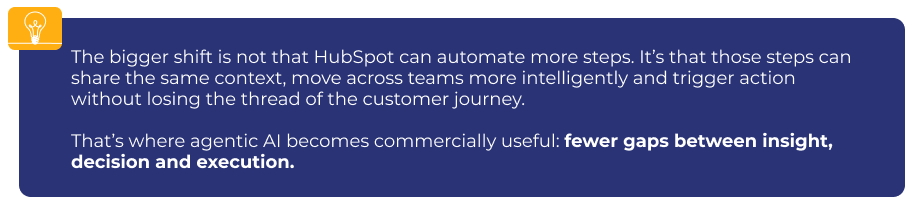
HubSpot’s move to an Agentic Customer Platform points to a bigger shift in how businesses will operate with AI.
The important question now is not whether agents will become part of the way we work, but what kind of operating environment we are building around them.
If an agent had access to your business tomorrow, would it understand your customers clearly enough to act well? Would it know when to move, when to pause, and when to hand over to a person? Would your teams trust its decisions?
And beyond the agent itself, what would it reveal about the business around it? Would it find clarity or confusion?
Those questions will shape whether agentic AI becomes genuinely useful or simply another layer of technology.
Not sure where agents could fit into your customer journey? Get in touch, and our experts can help you identify the right use cases, processes and guardrails to start with.
FAQs