Sales and marketing alignment is often discussed, but the real challenge is knowing what’s causing the friction. This article explores the common signs of misalignment in B2B businesses and how to diagnose the gaps affecting lead quality, reporting, campaign planning, and the customer journey.
Key Takeaways:
- Sales and marketing misalignment often shows up in small but important ways, like unclear lead handovers, inconsistent messaging, disconnected reports, or campaigns that don’t support sales priorities.
- Sales and marketing alignment means both teams understand the same buyer, work towards shared goals, and use the same data to guide decisions.
- In B2B, alignment matters because buyers interact with your brand in different ways before they’re ready to speak to sales. If teams aren’t connected, the buyer feels the gaps.
- Misalignment isn’t always about people not trying hard enough. It often points to deeper issues with goals, lead definitions, processes, reporting or ownership across the customer journey.
- A simple checklist can help you see where alignment may be breaking down, from lead qualification to campaign planning and reporting.
|
Sales and marketing misalignment is usually easy to feel, but not always easy to pinpoint.
You see it when sales teams aren’t sure which campaign a lead came from, or when marketing creates content that sales rarely use. You see it when both teams are busy, but the buyer experience still feels disconnected.
It’s tempting to jump straight to fixes: more meetings, leads, reports, or campaigns. But if you don’t understand the root cause of the misalignment, you may end up fixing the wrong thing.
That’s why sales and marketing alignment needs to be properly diagnosed, especially in B2B businesses, where the customer journey is longer and more complex.
That’s why B2B teams need to look beyond the symptoms and understand where the process is breaking down.
What is sales and marketing alignment?
Sales and marketing alignment is when both teams understand who they’re trying to reach, what matters to that buyer, and how each interaction should move them closer to a meaningful sales conversation.
It means marketing isn’t simply generating leads while sales tries to close deals separately. Both teams understand how leads should move through the business, what each team is responsible for, and how their work supports the same revenue journey.
In a well-aligned business, marketing efforts support the sales process, and sales insights help shape stronger marketing campaigns. Both teams can see what’s happening, understand what’s working, and use the same information to make better decisions.
That doesn’t mean sales and marketing do the same job. They have different roles, but they shouldn’t be working from different versions of the truth. The data shows this is still a common challenge for B2B teams.
Why does sales and marketing alignment matter in B2B?
In B2B, buyers rarely move in a straight line.
They may read your content, visit your website, attend a webinar, speak to sales, compare competitors, involve other decision-makers and then come back weeks or months later with more questions.
When sales and marketing aren't aligned, here’s what can happen:
 Aligning your B2B sales strategy with your marketing efforts helps both teams focus on the same ideal customer profile, use consistent messaging, and create a more connected customer journey from the first interaction to a closed deal.
It also improves visibility across the revenue process. Instead of marketing reporting on activity and sales reporting on deals separately, aligned teams can see which campaigns create opportunities, where leads get stuck, and what influences revenue.
What are the symptoms of sales and marketing misalignment?
Misalignment doesn’t always look dramatic.
Sometimes it shows up in small, everyday moments that seem harmless at first. But over time, those gaps start affecting lead quality, sales efficiency, reporting, customer experience and revenue growth.
Here are some common symptoms to look out for: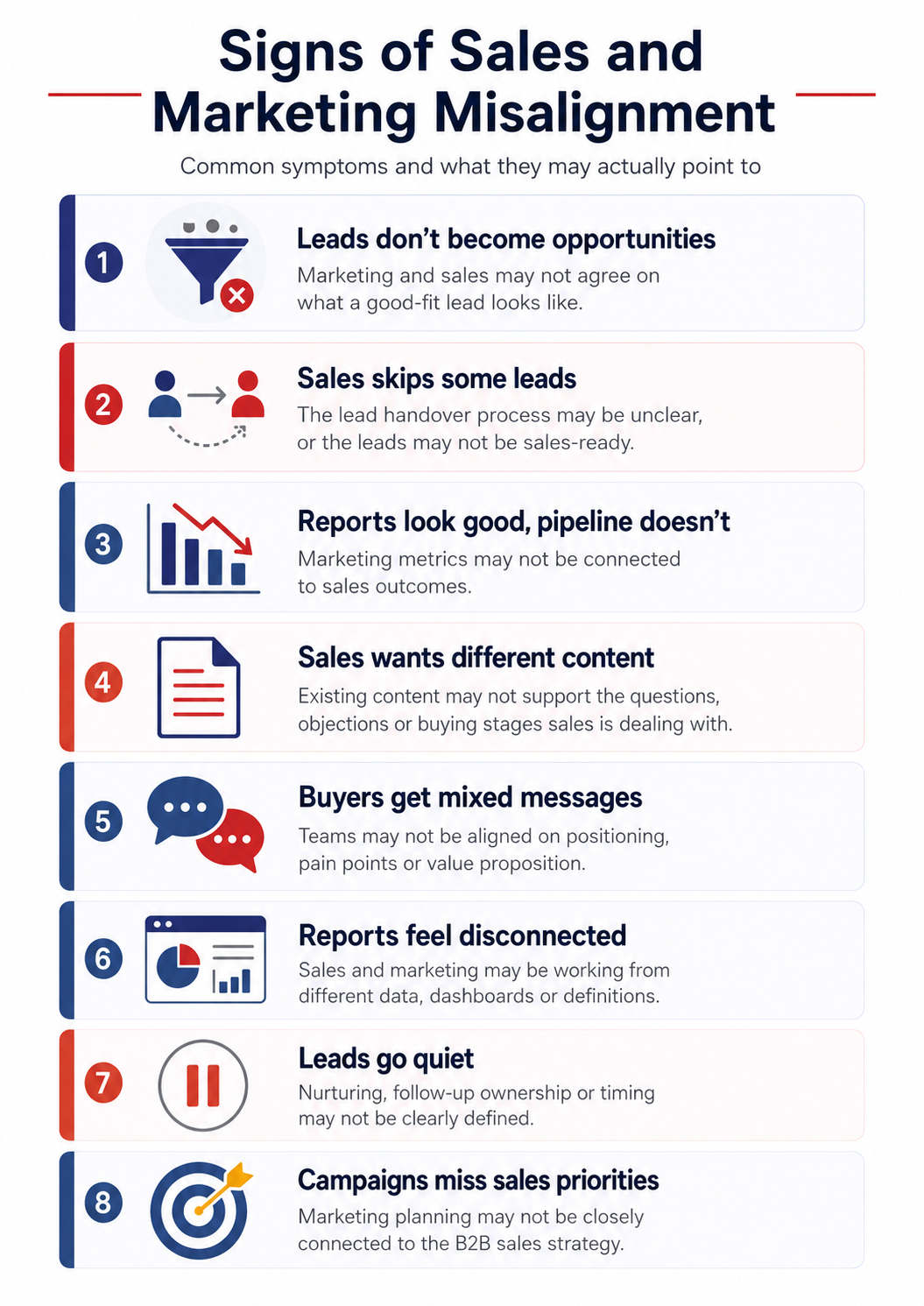 These issues usually point to a process problem, not a people problem.
What causes sales and marketing misalignment?
Once you’ve spotted the symptoms, the next step is to look at what may be sitting behind them.
In our experience, misalignment usually builds through small gaps in how the work is planned, handed over, measured and followed up.
“Sales and marketing can be targeting the same market, but not the same buyer or stage of readiness.” - Spitfire Team Insight
1. Teams define a qualified lead differently
Sales and marketing may use the same words, but they mean different things.
A “qualified lead” or “sales-ready lead” might mean one thing in a campaign report and something else in a sales conversation. That gap creates friction when leads are handed over too early, without enough context, or before sales can act on them properly.
2. Marketing activities aren’t connected to sales reality
Marketing may be focused on lead volume, campaign performance or content engagement, while sales is focused on pipeline quality and revenue.
This can create a gap between what looks successful in a marketing report and what sales can realistically convert into opportunities. A campaign may generate a high number of leads, but if those leads aren’t the right fit, aren’t ready to buy, or don’t match the conversations sales is having, the activity won’t translate into a meaningful pipeline.
3. Customer insight doesn’t always flow back into marketing
Sales teams hear buyer questions, objections, and concerns every day.
If that insight doesn’t make its way back into marketing planning, campaigns can start to rely on assumptions. The message may sound right internally, but it still misses what prospects actually care about in sales conversations.
4. Sales isn’t always equipped to follow up properly
Misalignment also happens when sales doesn’t have the right context, tools, or content to continue the conversation.
If sales doesn’t know which campaign a lead came from, what they engaged with, or what prompted their interest, follow-up can feel generic. Sales needs enough context to continue the conversation in a way that feels relevant to the buyer.
5. No one owns the customer journey end-to-end
Marketing may own awareness and lead generation. Sales may own conversations and opportunities. But buyers don’t experience those stages as separate departments.
When no one looks at the full journey, prospects can receive mixed messages, repeat information, or feel a drop in relevance as they move from marketing to sales.
6. Alignment isn’t maintained consistently
In busy teams, alignment often becomes a focus only when performance drops.
But sales and marketing alignment isn’t something you fix once and leave alone. It needs regular feedback, campaign reviews, clean CRM data, shared reporting and leadership accountability to keep both teams moving in the same direction.
How to diagnose sales and marketing misalignment?
Before you jump into fixing alignment, slow down and ask the right questions.
Use this checklist to spot where the disconnect may be happening. For each question, answer Yes, No, or Not sure.
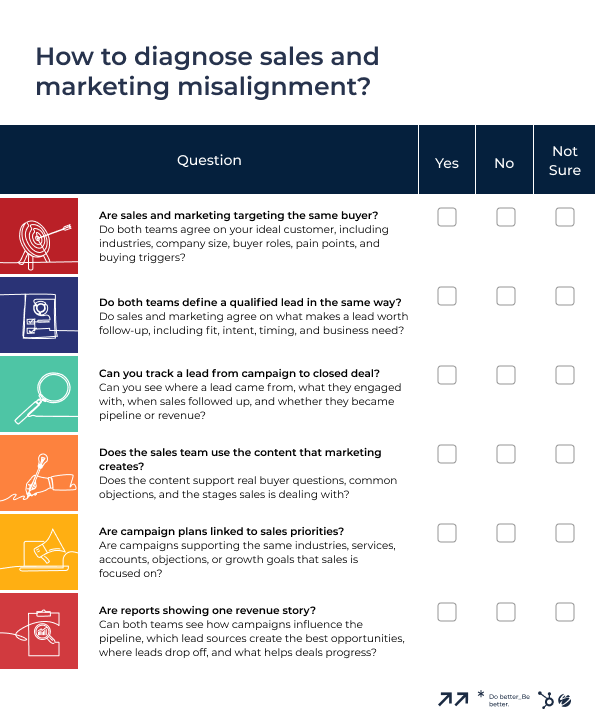
Diagnostic takeaway
If you answered “No” or “Not sure” to more than two of these questions, your business probably isn’t dealing with a lack of effort. It’s dealing with structural misalignment.
That means the issue may sit in how leads are defined, handed over, followed up or measured across the customer journey.
What are the best practices for aligning sales and marketing?
When it comes to aligning sales and marketing strategies, the goal isn’t to make both teams do the same job. It’s to help them work from the same view of the buyer and the revenue journey. Once you know where the disconnect is happening, you can start fixing it in a focused way.
Here are a few sales and marketing alignment best practices that make a real difference:
1. Agree on shared revenue outcomes
Sales and marketing can still measure different parts of the journey, but those measures need to connect back to the same commercial outcome.
Marketing may be tracking campaign engagement, while sales focuses on opportunity quality. Both teams can be performing well, but if those numbers don’t align, the business will still feel the gap.
Useful shared measures could include qualified pipeline, conversion rates by source, target account engagement, sales cycle improvement, or marketing-influenced revenue.
The aim is to create one clear view of what success looks like.
2. Define what a qualified lead means
Both teams need to agree on what makes a lead worth follow-up.
That definition should include fit, intent, timing, and the information sales need to continue the conversation properly.
Once agreed, it should be reflected in your CRM, forms, reports, and team processes.
3. Connect campaign planning to sales priorities
Bring sales into campaign planning earlier.
Ask what prospects are asking, which services need support, which industries are showing opportunity, what objections are slowing deals down, and what content would help sales have better conversations.
This doesn’t mean sales controls the marketing plan. It means marketing has better insight before building it.
4. Build regular feedback loops
Sales and marketing should regularly review what’s happening in the market.
Sales can share buyer objections, competitor mentions, common questions, and deal blockers. Marketing can share campaign performance, search trends, content insights, and audience behaviour.
Together, both teams can decide what needs to change.
5. Use your CRM as the shared source of truth
Your CRM should help both teams see where leads come from, how they engage, when they become sales-ready, what sales does next, and how opportunities progress.
But itonly supports alignment if the data is clean, the process is clear, and both teams use it consistently.
6. Align around the full customer journey
Sales and marketing alignment isn’t only about internal efficiency. It’s about creating a better experience for the buyer.
Both teams need to understand where buyers engage, what questions they ask, what objections slow them down, and what support helps them make a confident decision.
The clearer that journey is, the easier it becomes to align messaging, content and follow-up.
Read our blog on the three main benefits of aligning your sales and marketing goals and targets
The real test of alignment is the customer experience
Sales and marketing alignment isn’t just something your teams feel internally. It directly shapes how buyers experience your brand.
When teams are aligned, the journey feels clearer, the message is more consistent, and the follow-up is more relevant.
When they aren’t, the buyer feels the gaps.
That’s why real alignment starts with looking honestly at how your revenue process works, where your teams lose momentum and what the customer experiences as a result.
If your sales and marketing teams are working hard but not moving in the same direction, we can help you find the gaps and strengthen the way your teams work together.
Ready to diagnose where alignment is breaking down? Speak to one of our experts and take the first step toward a clearer, more connected revenue process.