Key Takeaways
-
Sales enablement solutions help financial service businesses connect their sales process, CRM, training, and reporting, so HubSpot supports how the team sells.
-
For financial services businesses, CRM design should account for adviser or broker relationships, data ownership, permissions, integrations, and regulatory requirements.
-
A sales enablement partner should go beyond HubSpot onboarding by defining qualification, ownership, handovers, reporting, training, and ongoing optimisation.
-
A clear sales enablement framework, like our Navigator OS, helps businesses move from discovery and process design into CRM configuration, training, and continuous improvement.
-
HubSpot can work well for mid-market financial services businesses when its role alongside specialist financial systems is clearly defined.
-
Platform accreditation tier and financial services track record are better signals of a capable sales enablement partner than general CRM experience.
Most finance teams don't need a new CRM. They need the one they already have to reflect how the team sells, and to keep doing that as the business grows. That is the job sales enablement solutions and CRM-driven sales support are there to do.
It is the work we do at Spitfire Inbound, a HubSpot Elite Solutions Partner working with mid-market financial services businesses in South Africa, Europe and further afield. We map how your team sells, configure HubSpot around that process, train the people who use it, and refine the setup over time.
In financial services, the CRM is the central nervous system and often has to support broker or adviser-led sales while still fitting around specialist systems and regulatory requirements.
Why finance CRMs struggle to gain adoption
CRM adoption problems often begin with vague process design.
Take a pipeline stage, such as Proposal Sent. Has the proposal been generated, approved internally, sent to the client, or acknowledged? Which information must be complete before the deal reaches that stage? If teams answer those questions differently, the pipeline data is already inconsistent.
Finance businesses also need the CRM to represent the relationships behind a sale. A brokerage may need to connect the brokerage, individual broker, end client, and opportunity. Flattening those relationships into a contact record and free-text notes limits reporting and complicates handovers.
Who receives an enquiry may depend on the product, region, adviser ownership, or an existing relationship. Those rules need to be agreed upon before automation is built.
What improves when Financial Service Businesses get sales enablement right?
The improvement should be visible in how the sales operation runs, not just in how the CRM looks.
Forecasts become defensible, because every stage means the same thing to every person reading the report. Lead response times drop, because routing rules are agreed before the automation is built. Qualification stops being a matter of individual judgement. Advisers find the current version of a document instead of the one in someone's shared folder. And leadership can finally compare lead quality by channel, see where follow-up slows down, and spot the stages where opportunities repeatedly stall.
We cover the wider case for sales enablement in How Sales Enablement Can Help Shorten Your Sales Cycle.
What does a sales enablement partner do?
HubSpot onboarding is one part of the work. Sales enablement defines how the CRM supports qualification, ownership, handovers, reporting, sales content, and day-to-day sales activity.
A qualified opportunity needs an agreed definition. Once that exists, HubSpot can require the right information, route the opportunity correctly, and report on conversion consistently.
Approved sales content also needs an owner and a clear place in the process. Advisers should be able to find the current material quickly rather than rely on whatever version happens to be in a shared folder.
CRM training should follow the workflow. An adviser needs to know how to progress an opportunity and what they must capture. A manager needs to know how to use the resulting pipeline data to coach the team and identify stalled deals.
It is worth separating two things that get used interchangeably. A sales enablement platform is software you buy; a sales enablement partner is who makes that software fit the way your team sells. Most Financial Service Businesses we work with already have the platform.
The Navigator OS: our framework for sales enablement
We use our proprietary Navigator OS; the operating system behind every HubSpot build we deliver, which encompasses five stages: Explore, Plan, Configure, Deploy & Train, and Enhance.
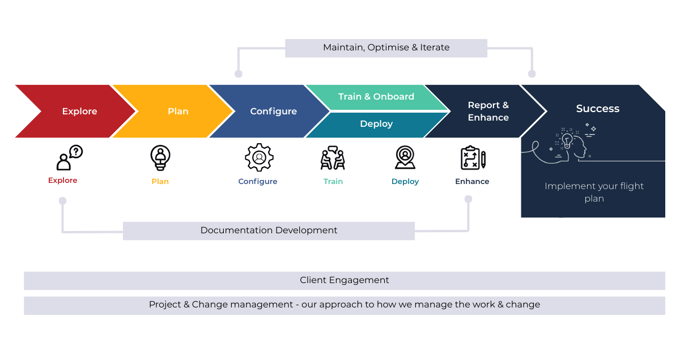
Explore examines the current sales process, HubSpot setup, reporting, and how the work teams have moved outside the CRM.
Plan turns that into agreed-upon rules for pipeline stages, qualification, ownership, data, and reporting. Where HubSpot sits alongside a policy administration or other specialist platform, this stage also establishes which system owns which information.
Configure builds those decisions into HubSpot through the relevant properties, pipelines, permissions, automation, integrations, and reports.
Deploy & Train tests the process with the people who use it and trains each role on its actual workflow.
Enhance uses CRM data and user feedback to refine the setup and assess new HubSpot functionality before adding it.
Read more about The Spitfire Navigator OS.
Who needs sales enablement support?
Sales enablement is useful when the sales process is too complex to rely on informal rules or the CRM no longer reflects how the team works.
The improvement should be measurable. A common definition of each pipeline stage should make reports more reliable and clarify what a salesperson needs to do before a deal moves forward. Marketing should also be able to see what happens to qualified leads.
Leadership can then compare lead quality by channel, see where follow-up slows down, and identify stages where opportunities repeatedly stall.
Read more about How Sales Enablement Can Help Shorten Your Sales Cycle
What makes CRM for financial services different in South Africa?
A CRM for financial services needs to align with the business’s approach to client data, record-keeping, and regulatory compliance.
POPIA requires organisations to take reasonable technical and organisational measures to protect personal information. FAIS record-keeping requirements also need to be reflected where they apply, and FSCA obligations shape how advised sales are recorded.
The CRM design then comes down to practical questions:
- Which client information needs to be in HubSpot?
- Who needs access?
- Which data stays in a specialist system?
- If the same information exists in both, which system is authoritative?
Those decisions affect permissions, integrations, automation, and reporting. Compliance specialists still determine the organisation’s regulatory requirements; the CRM should support the resulting process.
CRM for insurance brokers
An insurance brokerage rarely has a flat contact list. The CRM has to model the brokerage, the individual broker, the end client and the policy as distinct records, so that commission structures, renewals and adviser ownership all report correctly. Insurance CRM software that cannot hold that hierarchy forces the detail into notes, where it stops being reportable.
CRM for banks and lenders
For banks and lenders, the question is almost always integration. HubSpot handles the engagement, pipeline and reporting layer, while the core banking or lending platform remains the system of record. What matters is deciding where the boundary sits, and making sure the audit trail survives on both sides of it.
How do you choose a sales enablement and CRM consulting partner?
When assessing a CRM consulting provider, sales enablement specialist, or HubSpot partner, use the RFP process to test how they think about operations and technology.
Ask questions like:
- How will you document our current sales process before recommending a setup?
- How will you define stage criteria, qualification, ownership, and handovers?
- How will you decide what belongs in HubSpot versus our other systems?
- How do you approach permissions, integrations, and data ownership?
- How will training differ by role?
- What do you review after go-live, and how is the CRM improved over time?
- How will you work with our IT and compliance teams?
Here’s more about Choosing a HubSpot Partner: 7 Things to Check First
Is HubSpot the right CRM for a Financial Service Business?
HubSpot for financial services can suit mid-market businesses that want HubSpot to manage prospect and client engagement, sales activity, pipeline visibility, and reporting, while specialist platforms continue to handle transactional or product-specific data.
The CRM strategy needs to define that division before configuration starts. Duplicating a specialised financial system within HubSpot adds complexity, while isolating useful sales and client data limits the CRM.
Spitfire Inbound is a HubSpot Elite Solutions Partner, the highest accreditation tier HubSpot awards, which reflects the volume and complexity of the implementations we deliver.
How do you measure sales enablement ROI?
Measure the operational problem the work was designed to improve.
For lead handling, compare response times. For adoption, monitor data completeness and use of the agreed process. For pipeline performance, track conversion between stages and time spent in each stage.
Set the baseline before implementation so the business can see what changed.
In our work with Penquin, that approach produced 30% growth in sales. Read the case study.
Sales enablement beyond CRM setup
For Financial Service Businesses, sales enablement gives HubSpot a defined role in the sales process and a way to keep that setup current.
We use our Navigator OS Approach to build that process into HubSpot and refine it as your business grows.
Talk to our team about sales enablement and CRM support for your Financial Service Business.
FAQs: